Wednesday, March 14, 2018

9 Days In

So it has been 9 days since I switched to half-time at my regular day job and half-time on AMOS. Well actually it's working out to be significantly more than just "half-time" on AMOS, since a good chunk of my evenings have also been spent sourcing parts and trying to figure out the best possible way to put all this stuff together.

Some progress has been made over the past few days, albeit with a bit of a setback last Thursday: the day before I had written some test code for a sort of crude object detection algorithm, using image data from the two Raspberry Pi cameras. That evening I had re-drilled a hole for mounting one of the cameras, while the camera was still mounted on a post in its old hole. Very bad idea!!! Never drill next to a circuit board with tiny little parts if you can help it. Some small component (possibly an inductor or a zero ohm resistor?) fell off the board and was lost forever. I attempted to repair it myself, the next day, but ended up accidentally shorting out a connection (which I believe) fried the camera interface circuitry on my Raspberry Pi Compute module. So crap. Anyway, this required ordering both a new camera and Compute module. Hopefully they will be here soon.

I also got some code written for testing out a number of different things:

1. Code for turning on thrusters and controlling their speed and direction. Right now I have it limited to about 50 W per thruster, well below the maximum possible 350 W that they are capable of. This is a fairly small boat with limited power resources (10 Amp-hour battery) so I think 50 W per thruster is probably reasonable. Can't wait for the battery to arrive so I can try them out :-)!

2. Leak sensor code: this was pretty simple and worked as expected... I used the SOS leak sensor (https://www.bluerobotics.com/store/electronics/sos-leak-sensor/) from BlueRobotics and just had to monitor a GPIO pin to see if any of the sensors had gotten wet. A couple of drops of water on one of these little disc sensors caused it to swell up and grow (kind of like those kids toys that expand in water) and it must have changed its impedance or something because the digital output of the SOS leak sensor changed right away.

3. Code for sending SMS text messages: for this I used a service provided by Twilio (www.twilio.com). It was pretty simple to get going... basically I got a free trial account from Twilio which gives me a local phone number that can be used for sending and receiving SMS text messages. I think it can even do voice calls too, but I won't be using it for that. I'm not sure if the Twilio account will still be required once I have a cell modem up and running with actual data service, but it works great for now with my Wifi Internet connection.

A crude bathtub buoyancy test of the AMOS boat (beer cooler) showed that it will ride pretty high in the water if there isn't much weight in it. With 30 lbs worth of dumbbells inside, it sat a little bit lower, but tended to list to one side a lot if the weights were not well balanced. 

Last night I spent some time in the garage cutting out strips of plywood, with the intention of building a framework of sorts for supporting the 100W flexible solar panel. If possible, I would like to also mount the thrusters on the same framework and hopefully avoid drilling holes in the hull of the boat. Some holes will inevitably be required for cabling and the cameras, but these could be above the waterline, and would not be subject to significant stresses, such as might occur from the thrusters.

Lastly, I have ordered some more electronics components:

1. Micro 3G/GSM Shield for Arduino & Raspberry Pi ($120 Cdn)
2. Raspberry PI GPS Module ($47 Cdn)
3. LSM303D 3-Axis Accelerometer and Compass ($10 Cdn)

Just this morning I started writing some code for the LM303D; planning on connecting it to the I2C interface of the Compute Module. There's a lot of functionality packed into that $10 board, although I'm not sure how accurate it will be; my experience with other magnetometer-based equipment seems to be that you are "doing well" if you can achieve something like +/- 10 degrees of heading accuracy. With a working GPS though, this hopefully won't be too much of an issue. 


Sunday, March 4, 2018

Starting Tomorrow!

So tomorrow I officially switch over to half-time employment at my regular day job (software developer at Measurand Inc, www.measurand.com) and dedicate the other half of my day to development work on AMOS. The plan is to spend mornings at home, and afternoons at Measurand, but that may get changed around some, depending on what is going on. It's going to be a little bit weird at first I think, but I'm used to doing after-hours contract work and personal projects at home, so probably not that weird. The money thing could result in some stress after a while, we will see. I canceled my bi-weekly RRSP contributions so that will improve the cash flow situation a bit, plus I'm still doing a bit of after-hours contracting work, so hopefully the savings won't suffer too much.

Some more money was spent on parts last week, with the following things ordered:

1. ebay:
12v  10 Amp-hour Dakota Lithium LiFePO4 Battery  ($99 + $30 shipping)  BlueROV (see below) powers an entire ROV with 6 thrusters off of a battery that is only slightly bigger than this, so I'm hoping this one should be sufficient for AMOS, which will only have two thrusters.

2. Amazon:
ALLPOWERS 100W 18V 12V Flexible Solar Panel  ($215 Cdn.) It's supposed to be suitable for RVs and boats.

ALLPOWERS 20A Solar Charge Controller Solar Panel Battery Intelligent Regulator with USB Port Display 12V/24V  ($26 Cdn.)


3. BlueRobotics:
Two T200 thrusters (and two speed controllers) ($388):


Plus an SOS leak sensor ($29), a potting kit ($10), three 6 mm cable penetrators ($10) and three 8 mm cable penetrators ($13). Plus $27 shipping.


So something on the order of about $1000 in parts this week. This gets most of the big expenses out of the way though I think, at least as far as AMOS is concerned. I expect I'll need to spend a bit more than $2K once it comes time to do some fluorescent microscopy...   


Sunday, February 25, 2018

A Way Kooler Boat!

I spent a lot of time this past week scouring the Internet for a suitable boat or boat design that might work well for AMOS. Being more of a bits and bytes guy rather than a mech head, I was focusing on finding a suitable kit, or perhaps some DIY plans that might work well and not be too difficult to build. In the process, I discovered why my kids enjoy Pinterest so much... what a great site!!! I had thought that Pinterest was just about crafts and such, but in the span of about 10 minutes I was able to literally look at hundreds of different boats and boat designs, many of them very innovative. This one in particular really caught my eye and looked like it would be the perfect size for a robotic watercraft:

It's actually a beer cooler that can be towed behind a kayak or canoe, and holds up to 30 12 oz cans and 20 lbs of ice. It measures a little over 3 feet long, almost 2 feet wide, and about 1 foot high. It's called the CreekKooler, and I was able to pick it up on Amazon for a little over $200 Cdn, with free shipping. Considering the time and effort required for a kit or DIY project, or the cost associated with a more conventional larger boat, this cooler boat seems to make a lot of sense. After it has carried hundreds of microbial samples though, people might be a bit reluctant to use it to store their beverages...

Monday, February 19, 2018

AMOS (Autonomous Mini (or Microbial?) Ocean Surveyor

I have ignored this Blog for a while, but am starting it up again to chronicle the development of an exciting new project: AMOS (Autonomous Mini (or Microbial?) Ocean Surveyor. I have been wanting to do something in robotics for a while, and had toyed around a bit with ideas for a robot to pickup household clutter, or a robot for watering gardens, but then after an evening of watching various TED talks about robotics, I had a sudden inspiration: why not make a robot boat that could take water samples at multiple locations and measure microbial concentrations of those samples?

My family has been vacationing at Parlee Beach, NB for nearly all of my life, but the beach has been in the news recently for problems of E.coli and other bacteria in the water. Current testing has revealed the problem to be serious, but so far the sources of contamination have not been definitively identified. Also, the testing that has been taking place has been time consuming and laborious, and generally confined to the main beach itself. I thought it would be cool if the testing area could be expanded, and also simplified, so as to take a shorter length of time between sample collection and final test results.

Due to the ambitious nature of this quest, I have gone to half-time employment at my regular day job, but will still continue to do some contract work on the side, to help make ends meet. The extra hours freed up will be dedicated to making AMOS a reality.

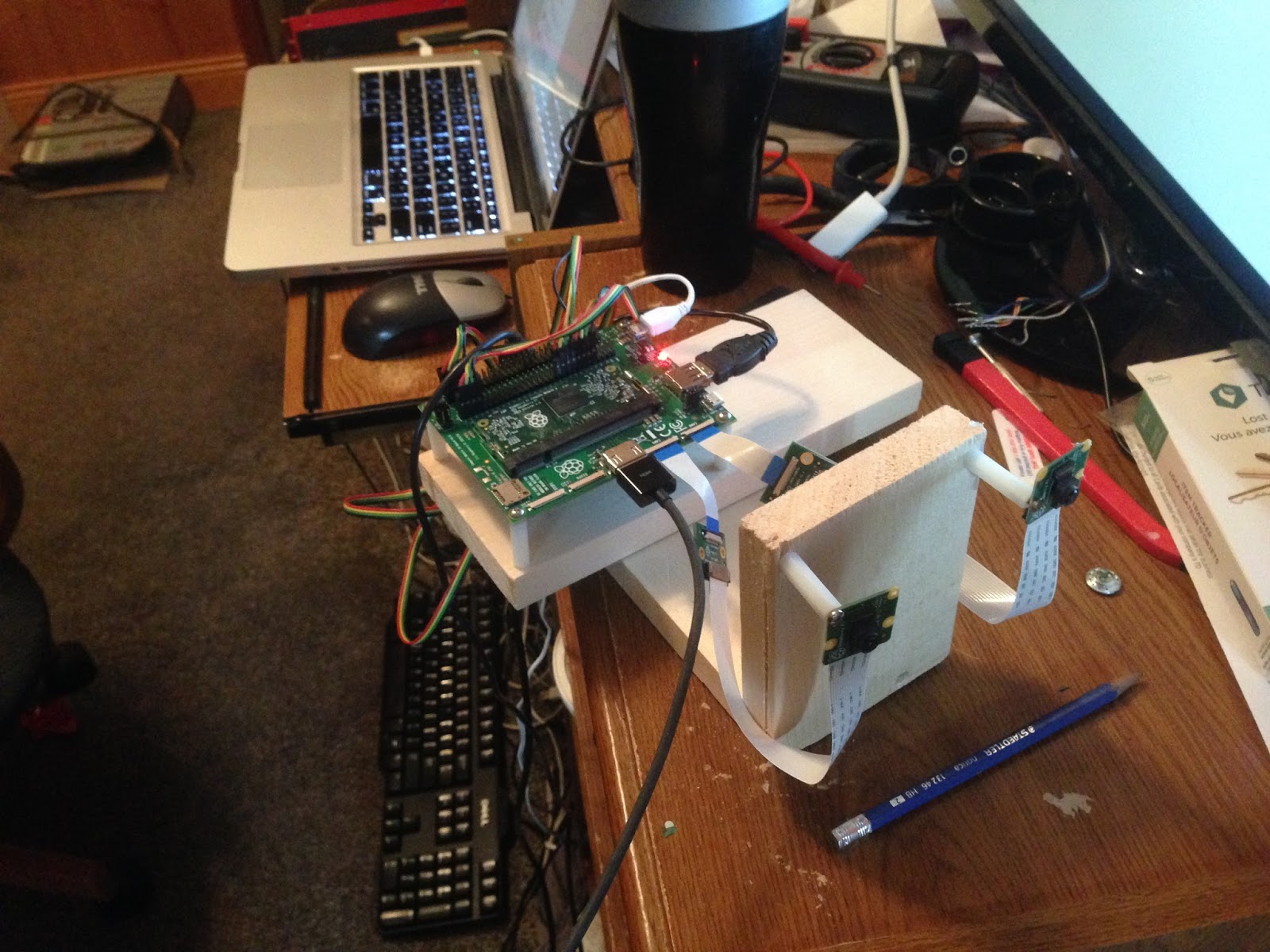
So far the beginning is small, just a raspberry PI Compute module with a couple of Pi V2 Camera modules:


This weekend I have been toying with a couple of different OpenCV library functions for feature detection. I would like to give AMOS some reasonable amount of computer vision so that it can identify obstacles on the open seas and avoid them whenever possible. I did some testing using Harris corner detection and the FAST algorithm for feature detection.

Harris Edge Detection

The FAST algorithm seemed to work a lot better and faster, so maybe it will form the basis of AMOS's object avoidance code.

FAST Feature Detection


Tuesday, December 20, 2016

Version 2.03 of Reader+ for Gmail

is now available here: https://itunes.apple.com/us/app/reader+-for-gmail/id959397919?ls=1&mt=8

This version has a cool new Delete feature for moving unwanted Gmail messages to the trash folder. It also fixes an issue with de-selecting folders that you don't want to listen to and offers some improved graphics. Here are some examples of the improved App Store graphics that Moments By Kassie made for me:


Tuesday, November 8, 2016

New Website!

Just added a new website that will hopefully help people find Reader+ for Gmail. Pretty basic right now, will have to do a bit of work to make it not look totally terrible! Anyway, here it is:

http://www.readerplusforgmail.com

Monday, November 7, 2016

First Ever $9.99 App Store Sale!

Imagine my excitement this evening when I signed into iTunes and found out that someone bought the "ad-free" version of Reader+ for Gmail yesterday for $9.99 US! A few days ago I had raised the price from $1.99 US to $9.99 US, in the hope that my meager number of sales would not be greatly reduced. Too early to say for sure yet (previously averaging maybe one $1.99 sale per 20 downloads) but this gives me hope.

In other news, version 2.01 with the date header fix is now approved and available:

https://itunes.apple.com/us/app/reader+-for-gmail/id959397919?ls=1&mt=8