Saturday, November 13, 2021
Mini AMOS
Thursday, October 7, 2021
Flexible Underwater Ribbon Cable Guide
The previous rigid 3-D printed shell that was used to join the underwater WeatherBox to the main electronics box on the AMOS surfboard needed to be replaced with something flexible that could flex and swing out of the way whenever underwater obstacles were encountered.
Some inexpensive plastic tubing was purchased at Home Depot, and 3-D printed adapter parts were constructed for either end of the tubing, to join it to the WeatherBox at the bottom end and the main electronics enclosure at the top end.
Friday, September 24, 2021
AMOS Captures Some Fish
Things have been busy lately, and there hasn't really been much occasion for taking AMOS out in the field. Over the last week though, I was able to develop some software for saving 30 fps 1920 x 1080 video files on AMOS, while still continuing to do all of its regular navigation and data saving stuff. Testing and debugging was done in the pool, and everything seemed to be working well.
This morning I took AMOS out to Kelly's Creek to test how the navigation, sensor data saving, and video recording all worked together. I was worried that the addition of the video recording in a real environment would slow down the other functions, possibly resulting in sluggish handling or missed data samples. Everything seemed to work pretty well though, although when I had plotted the course the night before, I had not realized how low the water level actually was. The waterline was about 10 m in from where it appeared to be on the ArcGIS map that was used to setup the course. Unfortunately, the WeatherBox that housed the camera underneath AMOS struck a rock at full speed, and the 3-D printed extension piece that connected it to the main electronics enclosure snapped under the strain. The WeatherBox was quickly flooded, but I was following close behind in the kayak and was able to turn off AMOS's power switch a few seconds later. Clearly a more flexible extension piece will be required here. Perhaps something like a short rubber hose could work?
Despite this accident, the rest of the test was a success. Depth, temperature, and conductivity data were all recorded normally, AMOS navigated itself normally, and 9 video files were recorded, mostly of air bubbles and river vegetation, but at 1:10 of the video below, you can see 3 small fish swimming by for a few seconds:
The end of the above video is where the WeatherBox struck the rock and the camera module was flooded. Unlike the last camera flooding which occurred in salt water, this one was in fresh water, and after storing the camera module in a bag of desiccant for 12 hours, it was confirmed to be unharmed.
Wednesday, September 1, 2021
AMOS Looks Underwater
Last month's assumption that the o-ring seal on the WeatherBox required improvement proved to be correct. The printed part had tiny imperfections underneath the o-ring that allowed water to slowly leak through. A WeatherBox customer who was using it to observe a muskrat underwater came up with a brilliant solution: he found that using some marine goop (ex. https://www.homedepot.ca/product/amazing-goop-marine-109-4-ml-3-7-oz-/1000183125) in the channel holding the o-ring worked to fill in the small imperfections in the plastic and create a watertight seal. I've built a few WeatherBox enclosures since then with the channel filled with Marine Goop and they have all worked quite well.
To take pictures and video underwater with the 6 foot AMOS surfboard, an extension piece was required to get the WeatherBox below the waterline. The bow of the surfboard where the camera is located is pitched upward at about a 20 degree angle, so this requires a curved extension piece. The creation of this extension piece required a couple of weeks. At first, rendering the model in OpenSCAD took days for my laptop to finish, although later iterations of the model used some 2-D optimizations with extrusions that shortened the rendering time to about 24 hours. The first two model attempts also had small gaps on the side with the largest radius of curvature, which led to leaking. Eventually a working model of the curved extension piece was created:
The extension piece was fitted on AMOS and used to capture this underwater backyard pool video:
Apologies to viewers for the acting talent used in the above video. In Nature Robotics operates on a tight budget. 😉Coming up next week is the final round of the 2021 edition of the Ocean Startup Challenge (https://oceanstartupproject.ca/challenge/). In Nature Robotics is in the mix again this year, and will be pitching on Thursday, September 9.
Wednesday, July 28, 2021
Drip, Drip, Drip, How to Make a Watertight Window?
Some work has been done over the last couple of weeks on trying to adapt the WeatherBox to function as an underwater camera enclosure. This work has been educational but not entirely profitable. Some underwater tests had been done in the pool, and at the time appeared to be successful, but they were too short (less than 5 minutes) to really prove out the leak-worthiness of the enclosure.
A longer test in a real-world environment confirmed that the enclosure leaks too quickly to be of any use for underwater pictures or video. A slightly modified version of the enclosure with a longer stem was attached to the underside of AMOS and used to record a video frame every second, for a 1 hour test along the shoreline in Cap Brule, New Brunswick. The stem was not really long enough to keep the camera underwater all of the time, and the mounting pins inside this particular enclosure had snapped off, so the camera board was not properly centered. The camera software uses an auto-brightness adjustment, which I think was confused by the alternating views above and below the water.
The camera ceased to function after about 20 minutes of operation. When the boat was taken out of the water about an hour later, it was half-full of sea water. The camera board was immediately rinsed and dried off, to no avail. A subsequent test confirmed that it no longer functioned at all.
Some decent depth, temperature, and conductivity data was collected for the test, showing a nice correlation between the 3 parameters: the shallower water was warmer and had a higher measured conductivity.
Temperature
Here is a video created from stringing the individual 1 Hz video frames together and increasing the playback speed by 5x. Not much to see really, just a lot of bouncing up and down and the occasional piece of seaweed:
Tuesday, July 13, 2021
AMOS Goes Camping
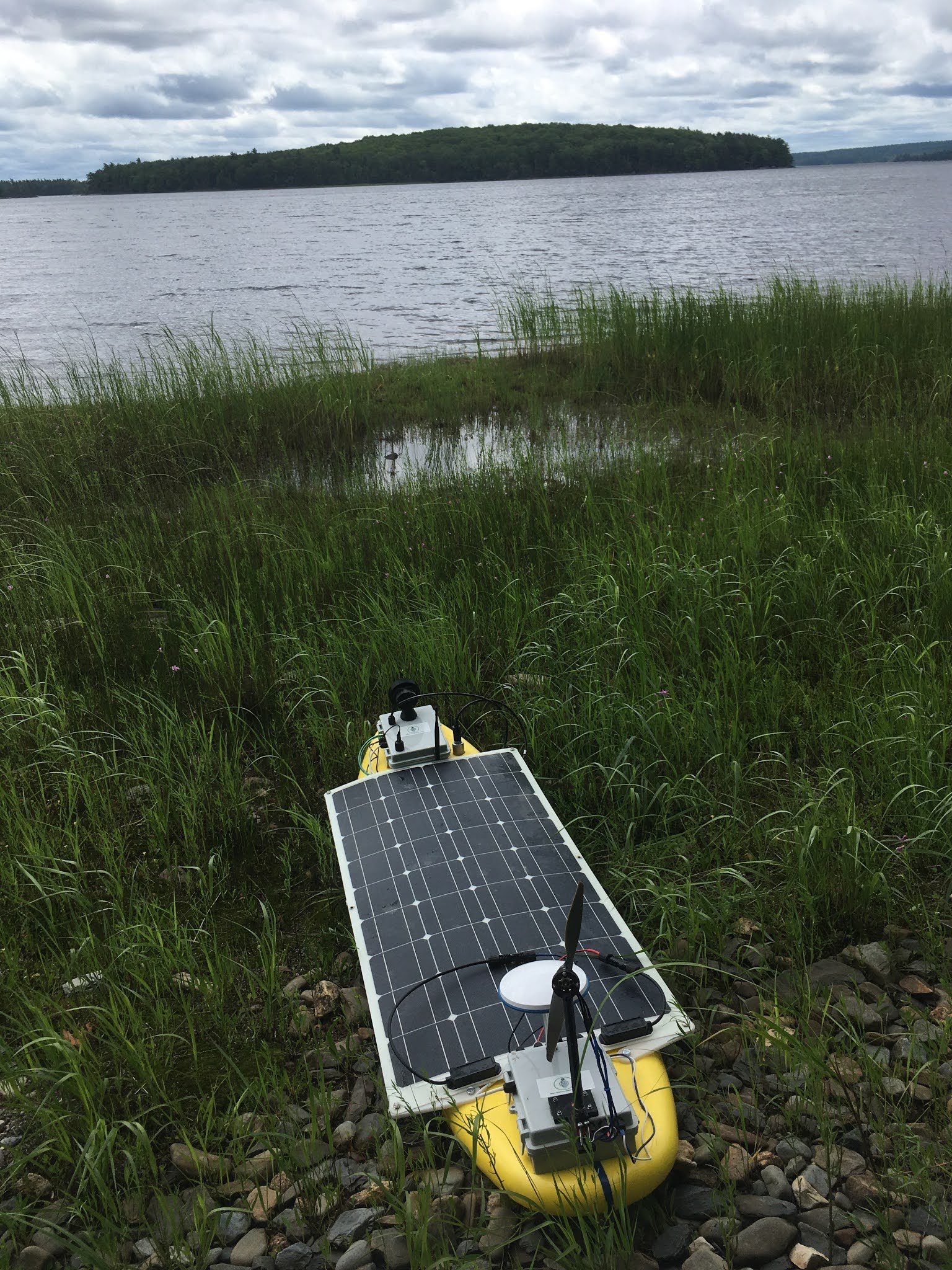
This past weekend I went with my daughter to her triathlon training camp at Kejimkujik National Park in Nova Scotia. We purchased a campsite for two nights and brought the tent, her bike and other triathlon-related equipment, a kayak, and of course AMOS! While Kirsten practiced swimming, biking, and running, I figured I could test out AMOS and follow around in the kayak.
The weather on Friday turned out to be awful though. Tropical storm "Elsa" passed through the area late in the day with high gusting winds and buckets of rain. The fly on our camping tent kept nothing dry, as rain was easily blown underneath, so that by Friday evening, it was basically raining INSIDE the tent too. We decided to put AMOS, the bike, and most of the other equipment in the tent, and ended up spending the night in the van instead.
Fortunately the weather on Saturday was much better, and by noon it turned into a sunny hot day. While Kirsten was training around Merrimakedge Beach, I mostly kayaked and observed AMOS as it followed a pre-programmed sampling course. Unfortunately I had forgotten to bring a necessary cable for the depth sensor, but did manage to get some good conductivity and temperature data over a few hours:
Tuesday, June 15, 2021
New Brunswick Road Trips
At the time of this writing, our home province of New Brunswick is closing in on its previously stated target of having given 75% of its populace at least one dose of a Covid-19 vaccine. The achievement of this target is supposed to lead to a loosening of restrictions, although I am not sure exactly what that means. Hopefully it will mean that we will be free to travel outside of the province sometime soon. In the meantime, AMOS has been busy traveling inside the province, doing demonstrations and collecting data.
On June 03, AMOS was in Salisbury, doing a demonstration at some local wetlands. This was for a community project organized by high school students Daytona McMackin and and Rhianna Johnston. Amongst those in attendance were a grade 5 class from a local elementary school, researchers from Mount Allison University, and members of the Petitcodiac Watershed Alliance.
photo credit: Jennifer Colpitts, J Colpitts Photography
The wetland area was fairly challenging in terms of its topography, with numerous grassy hillocks that required some careful route planning and / or manual driving to properly avoid. On a few occasions, these were not avoided, and AMOS became stuck, requiring a couple of outings in the kayak to nudge it into an area of deeper water. Apparently the demonstration was still suitably impressive for at least some of those in attendance: one grade 5 boy stated that he would ask his parents for an AMOS this year for Christmas. 😊
Here is the temperature and conductivity data collected with the AML Oceanographic probe:
The following week I took a trip back to the Lake Utopia area of New Brunswick, to sample Trout Lake, a small lake connected to the east end of Lake Utopia. The day was very hot and humid, and there seemed to be lots of fish (trout?) jumping out of the water to grab tasty flies. AMOS collected temperature, conductivity, and depth data over parts of the stream leading to the lake and the lake itself:
The above temperature data showed an interesting "cold zone" in the southeast corner of the lake where a stream emptied into it.
Much of the lake was quite shallow, although the middle area was a few m deep.