Showing posts with label Fredericton. Show all posts

Tuesday, August 4, 2020

Paddle Test Take 2

Despite the 3-D printed "paddle fail" of a couple of weeks ago, I had not given up on the idea of 3-D printing something for paddle propulsion. This time around, I made a simple rectangular paddle with a hollow tube along one edge for mounting onto the motor shaft. To test out the concept and see if a pair of paddles would generate sufficient thrust for AMOS, I used a chisel to gouge out some motor mounting holes in the old surfboard, and wired up (this time properly!) the DC motor controller to an Arduino Uno, and wrote a simple program for driving both motors at the same speed. 


It seemed like maybe it was faster than the air propeller version, although to be certain I guess I would need to program both boats for the same GPS course and race them against each other. It still remains to be seen how the paddles would fare in some of the weedy locations that the airboat frequents. This video recorded on the weekend shows the airboat version of AMOS moving through some pretty dense river grass (although the depth transducer and turbidity probe had to be pulled out of the water to minimize drag):


While AMOS was traveling through the river grass, it was also measuring the dissolved oxygen content of the water. From the few tests that I have done in the river near downtown Fredericton and out at Woolastook over the last couple of weeks, it looks like the dissolved oxygen content is dropping.  Here is the latest dissolved oxygen data from downtown Fredericton:


Dissolved oxygen content near downtown Fredericton on Aug. 02, 2020 varied from 5 mg/L (purple) to 9.1 mg/L (red). 

Unfortunately our humid weather over the last few weeks coupled with repeated testing has dissolved the construction adhesive that was bonding the foam pontoons to the aluminum plates. To remedy this, I spent about $13 for a tiny package of two-part "marine" epoxy. It is supposed to offer a bonding strength of 4000 psi, and be waterproof. So we shall see. I re-bonded the delaminated sections a few days ago, and it seems to be holding quite strongly so far!



Tuesday, June 9, 2020

Under The Bridge Obstacle Course

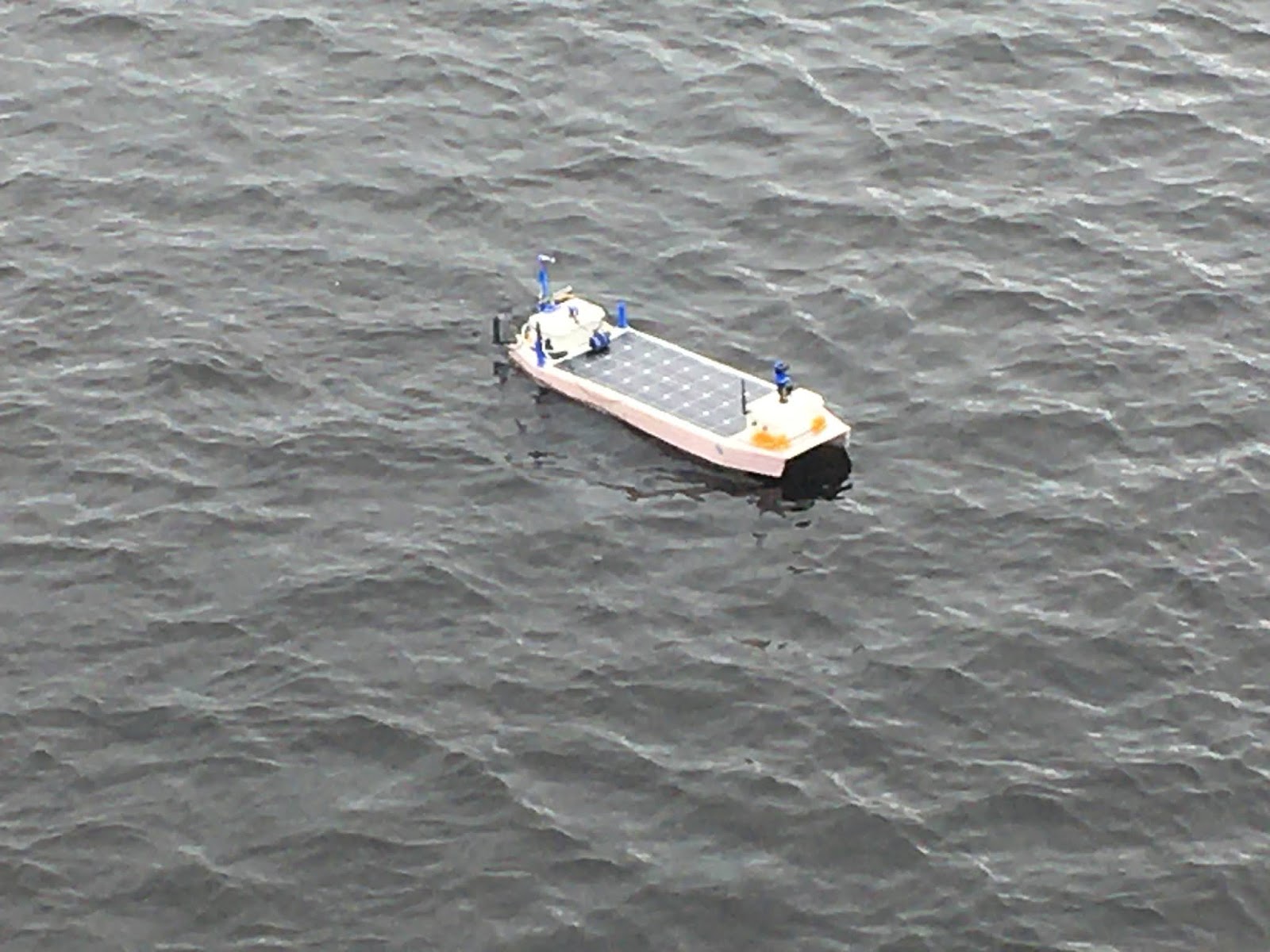
It had been a couple of weeks since AMOS's last trip on the river, and I was wondering if it would be possible to capture some good video from the deck of a bridge while AMOS traveled underneath, so on Sunday I brought the boat down to the boat launch at Carleton Park and set it on a course that would meander around the Bill Thorpe walking bridge for a while before heading back to Carleton Park. I enabled the LiDAR module for "obstacle avoidance" mode, in order to make sure that the boat did not crash into any of the large concrete pilings. I also brought the kayak in case anything went wrong, and paddled ahead of AMOS to the bridge, stowed the boat in some bushes, and then climbed up to the deck of the bridge to start filming.

The wind was coming out of the north at a about 13 km/h and the current was relatively strong, so AMOS arrived at the bridge quickly, but overshot a little bit and passed underneath before it was supposed to. Thereafter it fought gamely against the wind and current to get back on course, but tended to either (i) move backwards a bit during strong gusts or (ii) encounter a bridge piling obstacle, which resulted in the boat changing course to avoid the collision. The software navigation algorithm moves on to the next waypoint if it detects that the boat is either losing ground or has surpassed a particular waypoint, so the net result didn't actually turn out too bad. In the image below, the yellow path corresponds to the intended route, while the white is the actual route:


Although the weather was overcast and slightly rainy, AMOS still managed to last nearly 2.5 hours before it shut itself down to re-charge, just about 50 m from the planned destination!

Here is a collection of some of the images and video that I took, as well as some of the images that AMOS took with its camera:


Last but not least, here is the depth and temperature data:


Depth

Temperature: