Showing posts with label Water Quality Data. Show all posts

Tuesday, August 18, 2020

Read The Fine Manual

 Last Wednesday I was able to confirm by looking at the end of the dissolved O2 probe with a magnifying glass that there was a small crease in the membrane that was allowing air and water to leak in and electrolyte to leak out. So that confirmed why the previous readings had been getting progressively worse. Here is some better data collected at Woolastook with more electrolyte added and a new membrane over the end of the probe:

As you can see in the above screenshot, this time AMOS followed a route through the middle of the water, where it was relatively deep and there was little danger of damaging the end of the probe by dragging it against rocks, sticks, or other objects. The following graphs show the dissolved O2 data collected so far out at Kelly's Creek and near downtown Fredericton:


The results recorded in early August should be ignored, as the probe was most likely leaking at that time.

We entered an application in to the Ocean Startup Challenge last week: https://www.oceanstartupchallenge.ca/. I know of at least a few other people that have also entered submissions, so probably this contest was quite popular. On September 04, we will know whether or not our application made the short list. 

Just this evening I finished a 6-page quick start manual for getting up and running with AMOS. It hasn't been tested on anyone yet, although Kirsten volunteered to try it out and see if she could get it to work, so I'll try to take her up on that. Check out our support page: https://www.innaturerobotics.com/support to have a look. RTFM! 😀


Tuesday, August 4, 2020

Paddle Test Take 2

Despite the 3-D printed "paddle fail" of a couple of weeks ago, I had not given up on the idea of 3-D printing something for paddle propulsion. This time around, I made a simple rectangular paddle with a hollow tube along one edge for mounting onto the motor shaft. To test out the concept and see if a pair of paddles would generate sufficient thrust for AMOS, I used a chisel to gouge out some motor mounting holes in the old surfboard, and wired up (this time properly!) the DC motor controller to an Arduino Uno, and wrote a simple program for driving both motors at the same speed. 


It seemed like maybe it was faster than the air propeller version, although to be certain I guess I would need to program both boats for the same GPS course and race them against each other. It still remains to be seen how the paddles would fare in some of the weedy locations that the airboat frequents. This video recorded on the weekend shows the airboat version of AMOS moving through some pretty dense river grass (although the depth transducer and turbidity probe had to be pulled out of the water to minimize drag):


While AMOS was traveling through the river grass, it was also measuring the dissolved oxygen content of the water. From the few tests that I have done in the river near downtown Fredericton and out at Woolastook over the last couple of weeks, it looks like the dissolved oxygen content is dropping.  Here is the latest dissolved oxygen data from downtown Fredericton:


Dissolved oxygen content near downtown Fredericton on Aug. 02, 2020 varied from 5 mg/L (purple) to 9.1 mg/L (red). 

Unfortunately our humid weather over the last few weeks coupled with repeated testing has dissolved the construction adhesive that was bonding the foam pontoons to the aluminum plates. To remedy this, I spent about $13 for a tiny package of two-part "marine" epoxy. It is supposed to offer a bonding strength of 4000 psi, and be waterproof. So we shall see. I re-bonded the delaminated sections a few days ago, and it seems to be holding quite strongly so far!


Tuesday, July 21, 2020

AMOS WAS H

This weekend, a second attempt at writing a complete geo-message on the St. John River was made:


Due to the cloud cover that day, AMOS didn't have enough charge to complete the approximately 10 km message: "AMOS WAS HERE". The intended route was indicated in the above screenshots by the yellow path. The GPS points listed in the ship's log file are the white points at top, and the measured depth data (collected every second) appears below.

The dissolved oxygen software was coded last week, and the actual equipment arrived yesterday, so hopefully tomorrow I'll find some time to hook it up and try out the calibration routine (it can be calibrated in air to atmospheric oxygen levels). 

A few days were also devoted to working out some bugs (really just code that was never finished) for various network communications routines in the new BoatCaptain user software. 

We are also now trying to find beta test locations for AMOS. If you happen to know of anyone needing automated, geographically distributed water monitoring (preferably in Atlantic Canada), please let me know!!! 


Tuesday, February 11, 2020

Better Data For 2020

There are at least a couple of ways that AMOS could be updated to provide users with improved water quality data. One would be to add some industrial water quality probes that are capable of collecting calibrated data for a wide variety of parameters. Another would be to improve the data presentation software that is used to represent the data that AMOS collects. Some progress was made on both these fronts this week.

In order to continue updating the map-based data presentation software that AMOS uses, I first needed to get a new Esri ArcGIS license, as the free one I was using had expired. Luckily Esri offers a free account with some limitations for developers, which turned out to be good enough for my purposes. Using some temperature data that AMOS had collected last October, I was able to generate this nice color coded water temperature plot:


I think the color coded points on the data map look better than having blobs of varying sizes on the map. With color coding, you can also imagine a feature where data could be interpolated in the locations between sampling points by taking a weighted average of the surrounding points.

I have also been asking around and getting quotes from 4 of the major water quality probe manufacturers. Basically I would like to have a multi-sonde that comes with probes for temperature, turbidity, pH, dissolved oxygen, and blue-green algae. All of the manufacturers seem to support communications interfaces with 3rd party dataloggers, typically using RS-232 or RS-485. So far I have gotten prices from a couple of the manufacturers, and am waiting for quotes from the other two. The sensors are not cheap, so I want to do my research and make sure that the ones I decide on will be able to provide AMOS with reliable, accurate measurements.

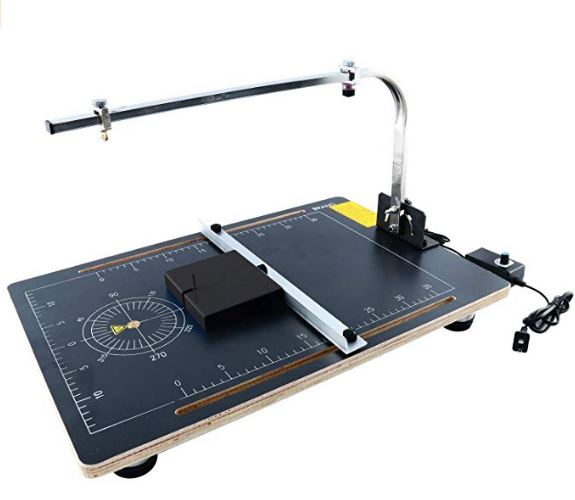
In preparation for an experimental catamaran version of AMOS, I found a hot-wire cutting device on Amazon that looks like it should be suitable for cutting through 2" sheets of pink insulation:

Hopefully it will help me to make more even cuts in the foam with fewer gouges and less time spent sanding.