Work on AMOS took a brief pause for Christmas, but has continued on during this final week of 2020. On Monday, I had wanted to do another test of the RTK / GPS equipment using a laptop hooked up to the base station equipment (in the playhouse) and a second laptop hooked up to the remote "rover" equipment, that was moved around the backyard. This was similar to the previous test done last week, except a laptop replaced AMOS as the rover. Using a laptop running Windows allowed me to run the Windows diagnostic software that came with the equipment, to see what mode the rover was in ("acquiring 3D position fix", "RTK float mode" or "RTK fix mode"). The latter of these modes provides the best position accuracy and precision, down to cm-level. The weather that day was a bit rainy and snowy, which required the use of this handy recycling box / makeshift laptop shelter:
Wednesday, December 30, 2020
Holiday AMOS Work
Tuesday, December 22, 2020
New AMOS Board
(EDIT, Jan. 07, 2021: For more info on AMOS and In Nature Robotics, please also visit https://www.innaturerobotics.com/)
It pained me somewhat to carve up a brand new surfboard fresh out of the box, but I used the two AMOS electronics boxes as guides to carve out rectangular holes in the bow and stern and then wedged the boxes in. The fit was pretty snug, so I didn't bother gluing anything down:
This last video showed a bit of a problem that the compass was having with giving accurate heading when the boat should have been moving south. The compass error must have been pointed towards the southeast, because the boat would start in that direction, realize that the new target direction was southwest (or even west) to get to the next waypoint, and then move in a big curve to correct for the initial path error. The temperature in the electronics box started off at 8 degrees C at the start of the test, and fell to 3 degrees C by the end. The magnetometer calibration was done at -3 degrees C, so that might have been a source of error. And probably there was some error from the Z-axis (vertical) magnetometer on the compass, since it had never been calibrated on this unit, and the new inclined angle of the bow on this boat would have caused that magnetometer to come more into play for determining heading.
Thursday, December 17, 2020
Testing Out New Gear
Since the test with the new motor described in last week's blog ended abruptly with a tree collision, I went back the following day to try again, this time with a better "cold-temperature" magnetometer calibration. I also launched the boat from the kayak, just beyond the trees as a precaution. There was a light wind, a fair bit of current, and the sun was out providing a bit of warmth. It was almost possible to forget that it was the middle of December.
The new motor did great - going against the current I believe it was a lot faster than the old motor would have been:
I ordered a 6 foot kids surfboard:
a feel for the accuracy / precision without using the RTK base unit, I put the rover unit on AMOS and carried it around the perimeter of our fence, about 1 foot inside the fence:
Thursday, December 10, 2020
New Build With New Motor
Much of the past few weeks have been spent assembling the electronics boxes for the next AMOS version. The LiDAR module just arrived yesterday, so it is not on yet, but pretty much all the other electronics are assembled, including a new motor.
Both boxes combined, and including the 10AH battery weigh only about 3.5 kg. In a pretty crude test involving a kitchen scale and the propulsion / battery box positioned with its back end on the scale, I was able to compare the lifting force of the two propellers for approximately the same input voltage, and the same 10" propeller. The new motor completely outstripped the old one, producing 2.5 times more lift for approximately the same input power, i.e. about 1300 g of force vs. about 500 g. Excited with these results, I strapped the electronics boxes onto the old AMOS surfboard:
And took it down to the river this morning for a test:I don't remember temperature having as profound an effect on the previous AMOS boats, but then again I only did a limited amount of testing at negative temperatures. So to be ready for the next test (assuming it will be somewhat close to -3 deg C), I re-did the circle calibration in the backyard (the original calibration was done at room temperature). It wouldn't be hard to have the boat do its own magnetometer calibration in the water. But better would be to calibrate and model the offset and possibly gain fluctuations of the AMOS-IMU sensors with temperature.
Tuesday, December 1, 2020
Building AMOS 4.0
The past couple of weeks have been spent putting stuff together for the next version of AMOS. It's going to be faster, more powerful, have a longer range, more accurate navigation, and it's going to look amazing. Some potential designs for the hull have been considered:
although nothing definite has been decided yet. Steven Fox, a mechanical engineering technician at Measurand has agreed to help me out with the hull design and construction in his off-hours, so no doubt he will greatly improve upon whatever I would have come up with. I had looked a little bit into 3D-printing or urethane casting for the next version, but these alternatives seemed quite pricey, and I wasn't sure how sturdy the finished product would be. So for now at least, it's looking like it is going to be another foam and fiberglass construction. Just better looking. 😎
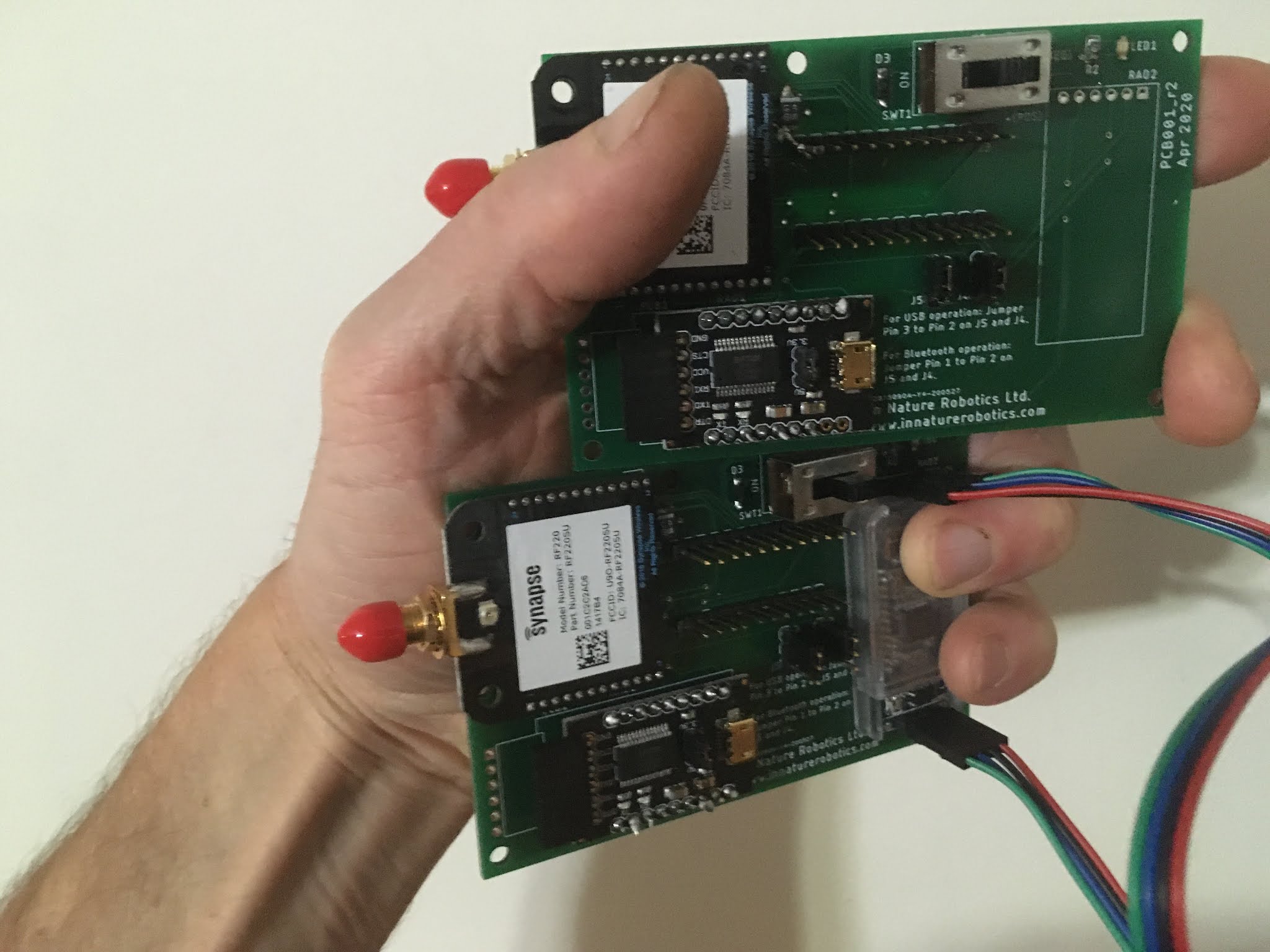
Prior to this build I watched a couple of how-to soldering videos on YouTube to refine my technique, and then put together a couple of AMOSRemote boards, one for the handheld unit and one for AMOS:
Tuesday, November 17, 2020
Breaking the mold
This weekend I tried out a plywood mold and two-part foam for building AMOS hulls. Everything went well for a while: I had the shed / playhouse heated at the right temperature (about 25 deg C), and got 5 or 6 batches of the foam properly mixed and poured into the mold. The foam expanded similar to what I had seen on the Internet beforehand, and there seemed to be a sufficient number of vent holes to relieve pressure from the expanding foam. Then I tried to take the mold apart. The interior had been lined with plastic wrap, in order to prevent the foam from sticking to the wood. Except it didn't work. The foam somehow tended to get underneath the wrap, and in some cases seemed to melt it and mix with it. I tried to hack and cut away at the wooden exterior of the mold, but only succeeded in breaking everything, including the foam pontoons. Here are some pics of the carnage:
Tuesday, November 10, 2020
The Cape Breton Tour
Later that day Lawrence and I drove to Whycocomagh in Cape Breton where we had rented a cottage on the shore of the Bras d'Or Lake. Here was our view from the front porch the next morning:
After the demo, Lawrence and I went out with Bruce and Allison and Piotr to check out a 50 m "Death Hole" with a couple of ROVs. This hole featured a mysterious layer of floating material about 16 m deep that both ROVs were able to examine with their camera systems. Allison and Piotr's ROV collected water samples for their lab at Dalhousie University using a very cool apparatus of spring actuated syringes. Bruce's ROV collected a smelly, dark sample of mud from the bottom of the hole:
On the return trip back to Dartmouth, Lawrence and I stopped near Antigonish to try collecting some data in Pomquet Cove. The wind here proved to be a bit too much for AMOS, so we tried a stream on the other side of the highway instead:
The water in the stream was a bit mucky and shallow in some areas, and required a few minutes of manually controlling AMOS to get it unstuck and drive it back to a location where it could be easily retrieved.
- More power, need a larger propeller, larger motor, and larger / more batteries.
- More streamlined and durable construction.
- More accurate positioning (i.e. requires a GNSS system).
- Need to have ability to reverse direction of propeller for backing out of tight spots.
- Software improvements for defining survey grids, saving / loading standard GPS coordinate file formats.