Wednesday, January 29, 2020

Wireless Transceiver Design and Possible Blue-Green Algae Pilot Project

One of the projects that In Nature Robotics has been getting some assistance with through IRAP (Industrial Research Assistance Program) and RPC (New Brunswick's provincial research organization) is the circuit board and case layout for the wireless transceiver used by AMOS. The project is nearing completion and the 3D models that I have seen so far look pretty nice:


 There are some remaining issues to sort out about making sure that everything fits into the waterproof box, but these should be solved soon.

Yesterday I had a good meeting with a project manager at the City of Fredericton to discuss AMOS and the possibility of doing a pilot study this summer for measuring blue-green algae levels in the St. John River. A few years ago some dogs died after drinking river water that was contaminated by toxic concentrations of blue-green algae in the river, so the city has some interest in setting up a monitoring program to detect when and where blue-green algae might be a problem.

Later on today I'll be speaking to the Raspberry Pint club... I'll post a quick update afterward on how it went!

Update: The presentation to the Raspberry Pint club went pretty well I think. I was a bit unprepared for the slideshow not working as planned under Google Hangouts, but it seemed to work acceptably well when not presented in full-screen mode.and there was some good interest and questions from the people in attendance afterward. There were other interesting projects presented also; my favorite was a 3.5" floppy disk drive that a guy had rigged up to play individual songs through Spotify. Basically each 3.5" disk had some Spotify-related links and text written to file(s) on the disk which were read and would start playing the desired song after the disk was inserted.

Wednesday, January 22, 2020

Digging Through The Past

A large part of this past week was spent looking through old blog entries, photos, and data to come up with material for my upcoming presentation to the Raspberry Pint club (see https://www.eventbrite.com/e/raspberry-pint-raspberry-pi-and-other-digital-making-fun-tickets-80736249295 for tickets and details). I read on the club's Facebook page that something like 100 people have signed up for the event so far, so it should be some great exposure for AMOS!

It was interesting to look back on all the work that was done for visual image processing for the purpose of object detection. None of this work (which consumed a couple months of my time) proved to be very reliable for finding objects, but some of the generated camera images were kind of cool:

The above photo was taken by the original AMOS in July 2018. A 640x480 color image from the Pi camera was processed using the Canny Edge Detection method. At the bottom of the image you can see the edge of the boat's hull, and in the middle you can make out a person paddling a small kayak in front of a bridge. The trouble with all of the visual object detection stuff though was that the appearance of the water was too variable. Too many waves, reflections, and nuances in color that made it very difficult to use an algorithm to find non-water objects.

As a bit of a distraction from the presentation stuff, I also continued plugging away at the data visualization software for AMOS. There is nothing ready to show there yet, which reminds me of one of my all-time favorite Dilbert cartoons:


Tuesday, January 14, 2020

AMOS AirProp and Negative Feedback

This past week saw a new product addition to the In Nature Robotics website, the AMOS AirPop: https://www.innaturerobotics.com/product-page/amos-airprop.


The AirProp uses a waterproof servo motor for directional control and a 2200 kv brushless drone motor for turning a 10 inch plastic propeller blade.

More work was completed on the mapping software for AMOS, adding the ability to open text map files for editing the desired route. I've also started working on adding software for viewing sensor data files. I have lots of sensor data collected from this past summer and fall, so it should be interesting to try out some different mapping and graphing techniques with it.

I've been trying new marketing things lately, I watched this video https://marketingperformanceacademy.com/wrong/ last night that gave me some ideas on what I can try changing. I also recently tried a one-day $10 Facebook ad campaign for the A to D board, and got about 2000 views, 33 clicks on the ad's "Learn More" button, and this friendly feedback from a Facebook citizen:

Really, I think this was $10 well spent. The pieces I used for product shots really do need to be cleaned up. They have messy looking soldering, the 3D-printed parts have burrs and imperfections, there are some rusty screws, etc. Might have to see what online services are available for some of that.

I ordered a bunch of In Nature Robotics Ltd. T-shirts for Christmas and have some extras.... this could be your lucky day, as the first 2 people to comment on this post will receive a free T-shirt:


For your comment just tell me who (or what) is your favorite robot, fictional or real, doesn't matter!

Wednesday, January 8, 2020

Presenting AMOS to the Raspberry Pint Club

I was asked to present AMOS to the Raspberry Pi club in London, England on January 29, 2020 at 19:00 GMT. Unfortunately In Nature Robotics does not yet have a budget for overseas travel but I will be doing the presentation via Google Hangouts. A few of us will present our projects, and then the group (about 30 to 40 people I am told) will head out to a local pub for some beverages. If you happen to be in London at the end of the month, you can check out the details of the event at this link: https://www.eventbrite.com/e/raspberry-pint-raspberry-pi-and-other-digital-making-fun-tickets-80736249295


During the last week of the Christmas break, I managed to educate myself a bit further about WebGL and Javascript programming, and now have some demo code completed for rotating a textured 3D cube in a web browser using the mouse. It's a long way from having a 3D online robot ordering system, but it's a start!

The automated anchor system now has its limit microswitches in place, mounted on the crane and a vertical post. These switches detect when the anchor weight is lifted up to the level of the crane and when the top motor rotates around to the vertical post respectively. Here is a short video showing how they work:


Tuesday, December 31, 2019

AMOS's New Year Resolutions Part 2

My blog post from a year ago happened to be the most popular in terms of views for 2019 by a long shot. I'm not exactly sure why. It was about AMOS's New Year resolutions, so maybe people were curious, or maybe it was just some fluke of Google Search that happened to funnel some people to my blog. At any rate, in this post I'll look at how AMOS fared in its resolutions for 2019, and then make a few new ones for 2020.


AMOS wasn't ready for autonomous operation until the end of August, which wasn't really optimal in terms of the amount of sunlight available. Its overall reliability was greatly improved over the 2018 version though, and it managed to operate autonomously for three consecutive days on two separate occasions. Had AMOS been ready to go autonomously back in May, it is conceivable that the full 1000 km total distance goal might have been attained. For getting more than 50 km in a single trip, I think this would only be possible with a larger battery.

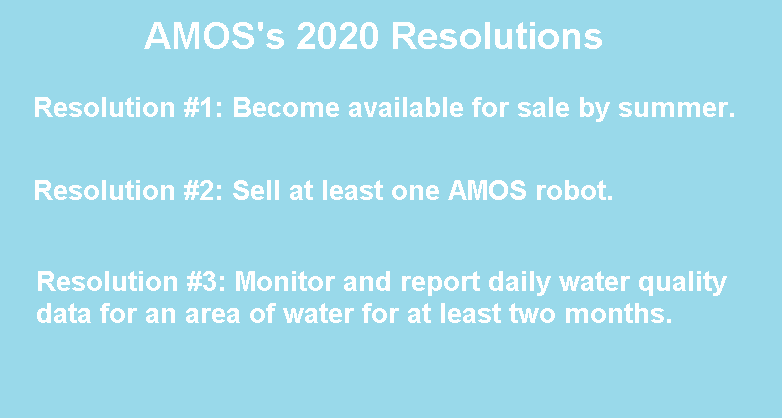
So just like most people, AMOS didn't quite stick to all of its resolutions. Now for the new ones in 2020:


Time will tell whether or not these are achieved. In working towards the first two resolutions, I am presently learning about JavaScript and WebGL in order to make an online custom ordering system for AMOS. The idea is to have a 3D web interface where you can pick and choose what elements of the robot you would like to have, see what the robot looks like in 3D, rotate it around, zoom in, etc., see its overall specifications and capabilities, and also see how many dollars the whole thing costs.


Wednesday, December 25, 2019

AMOS Featured in the MagPi

Merry Christmas / Happy Holidays!

I was planning on taking this week off from the blog, but just discovered this evening that AMOS appeared in the January 2020 edition of the MagPi: https://magpi.raspberrypi.org/issues/89/pdf. This is the official Raspberry Pi magazine. So definitely pretty cool, and worth bragging about! 😊

The magazine edition can be downloaded for free from the above link, but here are some screen captures of parts of it:


Tuesday, December 17, 2019

Starting to Get Real

A few small things happened this week that helped to reinforce my belief that AMOS can be a viable product.

On Friday, some market research reports that I had requested through Venn Innovation and MaRS Knowledge & Insights came in. In total there were 9 different reports mostly dealing with water monitoring technology. I've only read 2 of the reports so far, but it is clear that the World's water supply is increasingly being threatened by pollution, global warming, changes in weather, and other factors, and that there is a growing demand for reliable, effective monitoring technology for making sure that our water is safe. It seems clear to me that automated robotic water sampling will be needed in the future; hopefully AMOS can be part of that.

On the software side of things, with the help of the ArcGIS API, I came up with a pretty simple interface for planning a route for AMOS:

You basically just left-click the waypoints in the sequence that you want AMOS to follow, or right-click on a point to remove it. Then click the 'Save' button to save the route to a text file for upload to AMOS. It sure beats entering GPS coordinates by hand. I've made mistakes that have resulted in some serious head scratching when AMOS started to head off to the latitude and longitude of my typo.

In Nature Robotics now has an official presence on Twitter: @nature_robotics (https://twitter.com/nature_robotics). It was encouraging to see how many people there are on Twitter that are actively engaged in water monitoring and research about water. Many thousands to be sure. In Nature Robotics now follows a little over 200 of them, and will be following more gradually.

Over the course of the last 21 months that I've spent working on AMOS-related things, some spare parts have managed to accumulate around our basement. My part-time employer (Measurand Inc.) is having a Secret Santa gift exchange this year, with the rule being that the gift must be hand-made or less than $15 in price. Since I drew the Occupational Health and Safety Coordinator, I thought I could make some use of a spare humidity sensor and Arduino to help him make sure things aren't too hot, cold, humid, or dry in the workplace: