Tuesday, March 17, 2020

100% Work at Home

I have now switched to working 100% at home, to do my bit to help reduce the infection rate of the COVID-19 virus. The cold that I had last week seems mostly better now, and never developed into a fever or cough, so that's good at least. It's hard to say how long this thing is going to last; if the experience in China is anything to go by, it looks like we will be in for a rough couple of months at least.

On the AMOS front, last week I was able to get some 1/8" thick aluminum plates cut out and drilled by Marcus at Mason & Sons Metal Fabrication and Welding in Rusagonis, NB. Altogether the plates add a bit of weight (~ 6.8 lbs) but they are definitely quite sturdy and hold the pontoons together quite nicely. I also added some 1/4" diameter threaded rods to 6 locations around the perimeter for securing the solar panel with wingnuts. The threaded rods were held in place at first with a bit of construction adhesive, but they still felt a bit loose, so I added some Gorilla epoxy. They seem secure now, but I'll want to test them out a bit, as I suspect they might work their way loose over time. I'm thinking some long slots that the solar panel slides into might work better than threaded mounting posts.

Here is a picture of Kirsten holding the Cat version of AMOS with the aluminum plates:
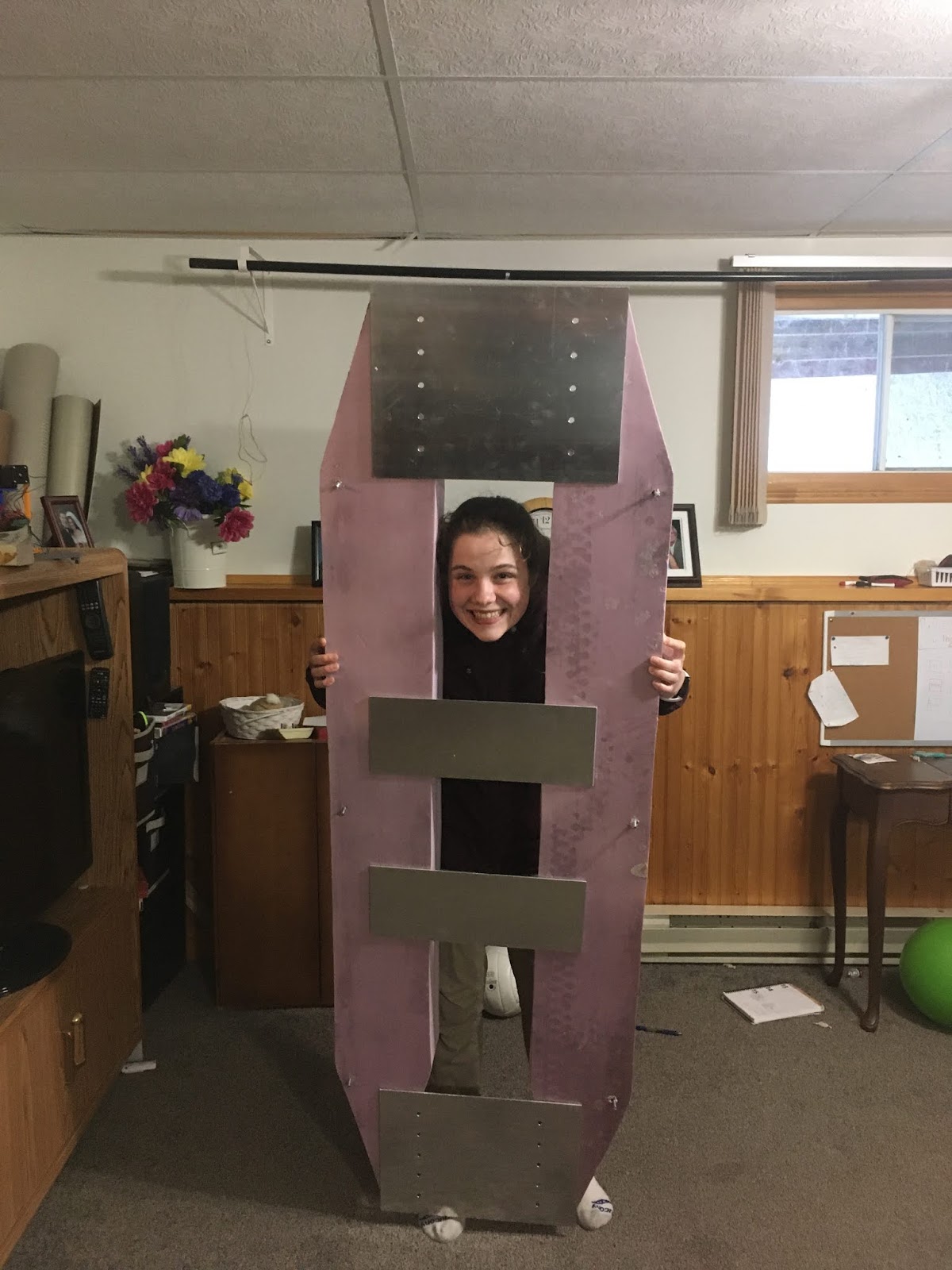

For now I'll just use the same electronics boxes that the surfboard AMOS had on the front and back metal plates. Later on I might try out smaller boxes recessed into the pontoons themselves. Having the boxes recessed would significantly cut down on wind resistance.

The software user interface for defining where and how to take pictures was completed just today. Here is a demo video that I made of laying out a route that leaves from Liberty State Park and circles around the Statue of Liberty, stopping to take 5 pictures of the statue at each of 4 different locations around Ellis Island. I won't actually attempt a field test of this route; it's just fun to imagine taking AMOS to exciting destinations while I'm stuck inside the house. :-)

Tuesday, March 10, 2020

102 Day Countdown

In order to meet the goal of having AMOS ready for sale by summer of this year, 3 main things will have to happen over the next 102 days:

1. Finish map-based user software for planning routes for AMOS, and viewing previously saved data and live data. PC, iOS, and Android versions of this software will be required.
2. Create documentation for the robot and its associated user software.
3. Update website with software, documentation, product pages, and custom ordering software.

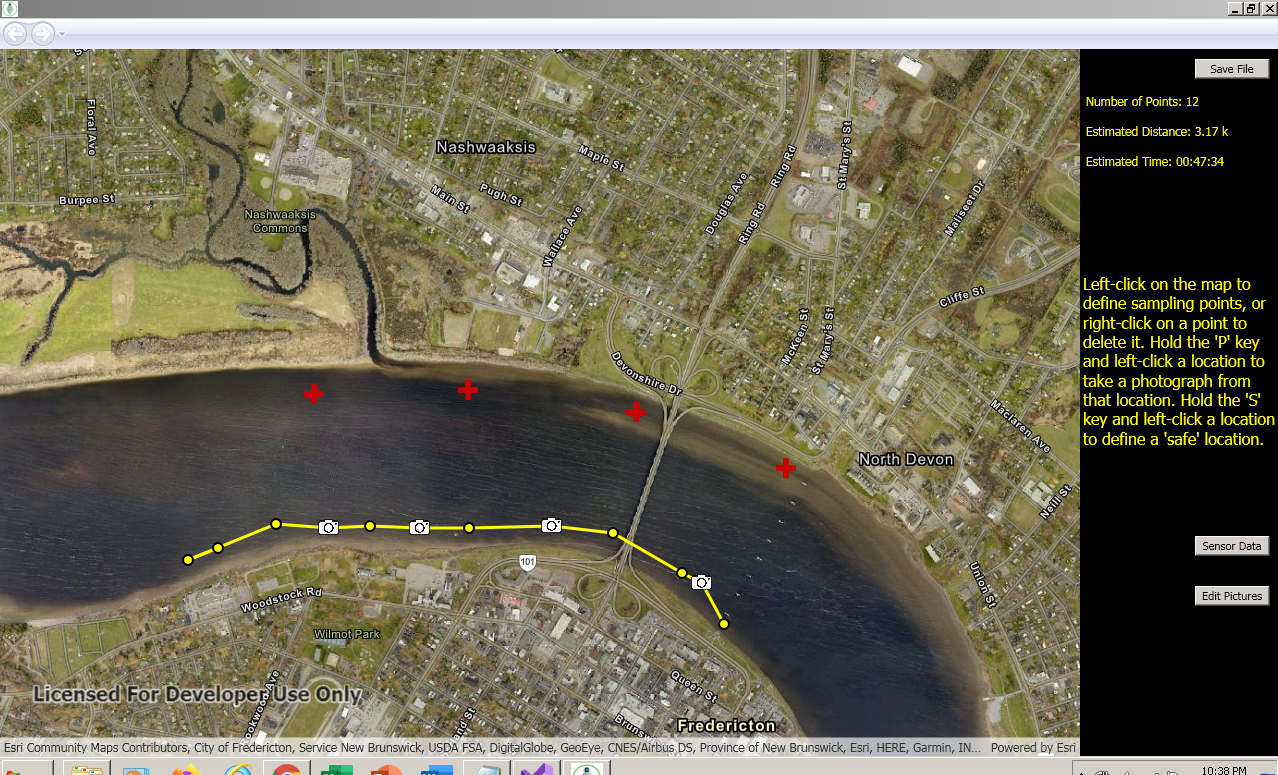
Some progress was made on the first of these this past week. The PC route planning software was updated to allow the user to define "safe" locations on the map (where AMOS can head to if it needs to re-charge) or picture locations where AMOS takes one or more pictures while pointed in a particular direction. The safe locations feature has been implemented on AMOS already, but the picture locations feature is something new. Possibly it's not a great idea to be adding new features at this point, but it seems like a feature that users would like, and it's not exactly straightforward to manually collect pictures with AMOS (like I have been doing up to now) by executing Linux shell commands. Right now the mapping software just requires the user to hold the 'S' key while left-clicking on the map to define a safe location, or hold the 'P' key while left-clicking to define a picture location.


The picture locations will also require some other parameters for specifying camera direction and number of shots. These will be set in a separate interface that the user can bring up with the 'Edit Pictures' button.

A co-worker at Measurand had suggested that I apply to the Volta Cohort: https://voltaeffect.com/cohort/. So I spent a day working on answers to their application questions. I am sure they will be receiving a lot of applications, but if my submission makes their initial cut I will have to go down to Halifax on May 13 to pitch In Nature Robotics on stage against 14 other startups.

The circuit boards for the wireless module arrived successfully from China last week. Coincidentally I developed a cold yesterday, but I'm sure it's unrelated. I've got one board mostly populated, but am just waiting on an FTDI-breakout board, which also happens to be arriving from China.

I drew up some simple aluminum plates for holding the two foam pontoons of the Catamaran version of AMOS together. There will be two 30 x 40 cm plates at either end of the boat to support the electronics boxes, and two 15 x 40 cm plates to support the center part of the boat and give it some structural stiffness. Hopefully the same construction adhesive that I used to glue the foam together will also work on the aluminum. It seems to be pretty strong stuff. Once those are finished I'll apply a fiberglass coating to the pontoons.

Tuesday, March 3, 2020

Meet Jata, Employee #1!

Thanks to some funding support from Venture For Canada, In Nature Robotics is pleased to announce that Jata MacCabe will be the company's first ever employee, working as a sales and marketing intern for the May to September summer term of this year. Jata is a multi-scholarship student and is currently completing her 3rd year of Computer Science at the University of New Brunswick, specializing in information systems. She has also completed a number of business and marketing courses and has extensive experience building and promoting digital communication platforms for small businesses, which should serve her well in her upcoming work term.


In less exciting news, I got the pontoons for the Cat-AMOS nicely sanded to a smooth finish, and visited a metal fabricator to inquire about possibly getting them encased in aluminum. The pontoons as built could not be encased in aluminum, since any welding process would certainly melt them, but it would be possible to make a twin-hull aluminum Catamaran that could be filled with some sort of spray foam, for buoyancy in the event of a leak or damage. The only problem is that any sort of aluminum structure of the size required to hold the solar panel and electronics boxes would weigh at least 35 lbs, probably more. The current surfboard design is only about 29 lbs, with the battery, electronics boxes, and everything included. So I guess I'll be sticking with a fiberglass shell for the foam pontoons. Hopefully I'll take better care around the edges this time to make sure that everything is nice and smooth without any fiberglass splinters. 

I also got more done on the ArcGIS-based mapping software for viewing diagnostic files recorded from AMOS. The following video is an example of the interface for viewing where the boat traveled, and what its internal temperature, voltage, and heading was at any given point of time.


Wednesday, February 26, 2020

In Nature Robotics Expansion?

Thankfully my knee surgery on Monday went well (according to the operating surgeon) so this week is mostly being spent doing computer work in bed or on the sofa. Before leaving for the surgery though, I did manage to cut out a couple of pontoon shapes with the hot wire cutter, that will be later glued together. It was a bit harder to maintain a straight line than I had expected, so some sanding and smoothing will still be required after they are glued together.


I'll also need to cut out another pair of pontoons, so that they can all be glued at the same time.

On Friday of last week I carried AMOS across the University of New Brunswick (UNB) campus on a freezing cold -26 deg C morning to meet with some professors who might be willing to provide an evaluation of AMOS with respect to its mechanical and software design. The evaluation could include up to 40 hours of their time, but would require approval from IRAP in order to get funding.

The day before that, I had a Webex conference with some people from Esri, the company that makes the ArcGIS software that AMOS uses for posting data, planning routes, etc. This was to find out if In Nature Robotics would be a good fit for their startup program. Last night I got a confirmation email that In Nature Robotics was in fact accepted, pending some document signing. This could be a good opportunity to market AMOS to other companies that are already using ArcGIS for map-based data collection of environmental data. It also comes with up to 3 years of free usage of their software and support.

Lastly, and perhaps most significantly, I got an email notification from the Venture For Canada website a few days ago, to let me know that they did not actually have an automatic notification system available to let employers know when someone had applied to one of their job postings. As I got absolutely zero traction with the posting I had created last fall for the winter term, I had assumed that the posting for the spring term had gotten a similar (zero) response. But actually there were 6 applications there, some of them quite good! So stay tuned to find out if In Nature Robotics will be doubling its work-force soon...

Tuesday, February 18, 2020

Interpolated Data Maps & Cat Boats

Last week some more time was spent on adding a data interpolation feature to the data mapping software. The result turned out pretty good I think:


I would also like to create some mapping software for monitoring AMOS in real time or after the fact via a saved log file. It could be used to pinpoint exactly where AMOS was at any given point in time, the route that it took, what the diagnostics outputs were over time, etc. The mapping software I have done so far has used the ArcGIS .NET software development kit from Esri. I actually have a Webex conference with Esri on Thursday to discuss possibly joining a program for startups that they have. 

The other activity for this week was coming up with a basic layout / design for the catamaran version of AMOS:


I'm not really sure yet if I like it or not. It is shorter than the current version of AMOS (6 feet long instead of 8 feet) and approximately the same width and height, so that's good I guess. I'll think about it for a day or two maybe before cutting up a bunch of EPS foam with the new hot wire cutter (btw the new hot wire cutter works great, I tried it out on a few scrap pieces of EPS).

On a personal note, I am undergoing knee surgery this Monday to fix a small tear in the meniscus of my left knee. I'm not sure what it will mean in terms of mobility, so maybe next week will just be spent writing code in bed. 😊


Tuesday, February 11, 2020

Better Data For 2020

There are at least a couple of ways that AMOS could be updated to provide users with improved water quality data. One would be to add some industrial water quality probes that are capable of collecting calibrated data for a wide variety of parameters. Another would be to improve the data presentation software that is used to represent the data that AMOS collects. Some progress was made on both these fronts this week.

In order to continue updating the map-based data presentation software that AMOS uses, I first needed to get a new Esri ArcGIS license, as the free one I was using had expired. Luckily Esri offers a free account with some limitations for developers, which turned out to be good enough for my purposes. Using some temperature data that AMOS had collected last October, I was able to generate this nice color coded water temperature plot:


I think the color coded points on the data map look better than having blobs of varying sizes on the map. With color coding, you can also imagine a feature where data could be interpolated in the locations between sampling points by taking a weighted average of the surrounding points.

I have also been asking around and getting quotes from 4 of the major water quality probe manufacturers. Basically I would like to have a multi-sonde that comes with probes for temperature, turbidity, pH, dissolved oxygen, and blue-green algae. All of the manufacturers seem to support communications interfaces with 3rd party dataloggers, typically using RS-232 or RS-485. So far I have gotten prices from a couple of the manufacturers, and am waiting for quotes from the other two. The sensors are not cheap, so I want to do my research and make sure that the ones I decide on will be able to provide AMOS with reliable, accurate measurements.

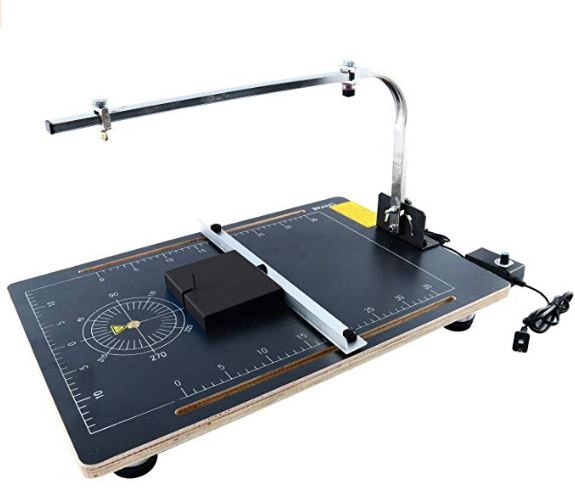
In preparation for an experimental catamaran version of AMOS, I found a hot-wire cutting device on Amazon that looks like it should be suitable for cutting through 2" sheets of pink insulation:

Hopefully it will help me to make more even cuts in the foam with fewer gouges and less time spent sanding.

Tuesday, February 4, 2020

Workation Time

The update at the end of last week's blog mentioned that the presentation to the Raspberry Pint club went pretty well; if you would like to see the presentation (and the other presentations from that evening) you can do so at the following YouTube link:


The slides from the presentation can also be found here: https://drive.google.com/drive/u/1/folders/12L3EXMMcrxIQD2Ic7eXweo_RAyHzjQuS

I find it amazing how much I say "ummm"  and "ahhh" when speaking. It's not something I'm actually aware of when speaking, so not too sure how to go about fixing it. Maybe hire a public speaker if AMOS ever takes off.

This week I had to travel down to San Diego for some meetings related to my job with Measurand. Luckily though, we got finished a bit early, so I was able to find some time to get out and enjoy the southern west coast sunshine and do a tour of this massive boat (the USS Miday):


I spent a few hours touring the boat, which was de-commissioned in the early 90's and converted to a museum about 15 years ago. Here's a nice pic of the San Diego downtown, taken from the flight deck: