Tuesday, August 18, 2020

Read The Fine Manual

 Last Wednesday I was able to confirm by looking at the end of the dissolved O2 probe with a magnifying glass that there was a small crease in the membrane that was allowing air and water to leak in and electrolyte to leak out. So that confirmed why the previous readings had been getting progressively worse. Here is some better data collected at Woolastook with more electrolyte added and a new membrane over the end of the probe:

As you can see in the above screenshot, this time AMOS followed a route through the middle of the water, where it was relatively deep and there was little danger of damaging the end of the probe by dragging it against rocks, sticks, or other objects. The following graphs show the dissolved O2 data collected so far out at Kelly's Creek and near downtown Fredericton:


The results recorded in early August should be ignored, as the probe was most likely leaking at that time.

We entered an application in to the Ocean Startup Challenge last week: https://www.oceanstartupchallenge.ca/. I know of at least a few other people that have also entered submissions, so probably this contest was quite popular. On September 04, we will know whether or not our application made the short list. 

Just this evening I finished a 6-page quick start manual for getting up and running with AMOS. It hasn't been tested on anyone yet, although Kirsten volunteered to try it out and see if she could get it to work, so I'll try to take her up on that. Check out our support page: https://www.innaturerobotics.com/support to have a look. RTFM! 😀


Tuesday, August 11, 2020

Leaky Dissolved O2 Sensor?

 After acquiring a few weeks of experience with the new dissolved oxygen sensor on AMOS, I am unfortunately a bit disappointed with its performance. Software-wise and electrically it worked great. They have some nice simple I2C and serial commands for getting data and calibrating, and you can get temperature compensated data at a rate of about 1 Hz. The bad part is that the calibration doesn't seem to hold for more than a few hours. The sensor probe is a galvanic one, in the sense that it uses an anode and cathode surrounded by an electrolyte to produce an electric current (and small voltage) when oxygen molecules cross over the probe's membrane. If I fill the probe with electrolyte (requires ~ 2 ml), calibrate, and then do a test run with AMOS, the results seem generally pretty good. If I go out again even just a few hours later, the results seem a bit lower, and then lower still the next day. Even re-calibrating doesn't really seem to work very well if it has been a long time since the initial filling of electrolyte solution. The membrane on the probe is quite thin, and a bit flimsy (slightly thicker than saran wrap), so I'm wondering if it just doesn't make a very tight seal? The online shop where I bought the sensor sent me an email request to review it, so I gave it a mediocre 3 stars with a description of the issues I was having. They said that they would forward my comments to the manufacturer, so we'll see if I hear back. 

Anyway, here are some pretty good results obtained near downtown Fredericton on Saturday, about an hour after filling with electrolyte and calibrating:

The dissolved O2 readings were all within a narrow band of 9.1 to 9.2 mg/L, which is a normal, expected level for the amount of oxygen dissolved in water. 

Later that afternoon I took AMOS out to Woolastook to collect some more data, but this time the readings started off a bit under 9 mg/L, jumped around a bit, and then seemed to gradually drift lower to under 5 mg/L as AMOS traveled along the 4 km route:

Today I re-visited Woolastook, and performed a re-calibration before leaving, but did not re-fill any of the electrolyte. This time the dissolved O2 started off at around 7 mg/L, and then dropped down to nearly 0 mg/L about halfway through the test: 

Since I saw a number of small fish swimming around, I don't think the level could have possibly been that low! I'll try going back tomorrow, but will top up the electrolyte again to see what difference that makes. The probe manual is vague about how often re-calibration is required, but does say that the electrolyte should last for about 2 years before it is depleted. Perhaps there is an issue with dragging the probe behind AMOS? It is mostly horizontal while AMOS is moving. Or maybe the probe membrane is getting damaged by dragging it through shallow water, grass, etc. close to the shoreline? I'll try not to waste too much more time on this, but these things kind of bother me! 😖


Tuesday, August 4, 2020

Paddle Test Take 2

Despite the 3-D printed "paddle fail" of a couple of weeks ago, I had not given up on the idea of 3-D printing something for paddle propulsion. This time around, I made a simple rectangular paddle with a hollow tube along one edge for mounting onto the motor shaft. To test out the concept and see if a pair of paddles would generate sufficient thrust for AMOS, I used a chisel to gouge out some motor mounting holes in the old surfboard, and wired up (this time properly!) the DC motor controller to an Arduino Uno, and wrote a simple program for driving both motors at the same speed. 


It seemed like maybe it was faster than the air propeller version, although to be certain I guess I would need to program both boats for the same GPS course and race them against each other. It still remains to be seen how the paddles would fare in some of the weedy locations that the airboat frequents. This video recorded on the weekend shows the airboat version of AMOS moving through some pretty dense river grass (although the depth transducer and turbidity probe had to be pulled out of the water to minimize drag):


While AMOS was traveling through the river grass, it was also measuring the dissolved oxygen content of the water. From the few tests that I have done in the river near downtown Fredericton and out at Woolastook over the last couple of weeks, it looks like the dissolved oxygen content is dropping.  Here is the latest dissolved oxygen data from downtown Fredericton:


Dissolved oxygen content near downtown Fredericton on Aug. 02, 2020 varied from 5 mg/L (purple) to 9.1 mg/L (red). 

Unfortunately our humid weather over the last few weeks coupled with repeated testing has dissolved the construction adhesive that was bonding the foam pontoons to the aluminum plates. To remedy this, I spent about $13 for a tiny package of two-part "marine" epoxy. It is supposed to offer a bonding strength of 4000 psi, and be waterproof. So we shall see. I re-bonded the delaminated sections a few days ago, and it seems to be holding quite strongly so far!


Tuesday, July 28, 2020

AMOS: Will Work For Beer!

This past weekend I had some time to take AMOS out on the St. John River in a couple of locations to test out the new dissolved oxygen sensor. The first location was just south of the Walking Bridge in downtown Fredericton, near the West bank of the river. AMOS did a short up and down run there on Friday and Saturday:

Dissolved oxygen levels on Friday (July 24) ranged from 14.2 mg/L to 15.6 mg/L. There had been a strong thunderstorm with about 10 ml of rain, about 5 hours before the readings were taken. Rain water absorbs oxygen from the atmosphere as it falls, so that can increase oxygen levels in surface water, especially near land where the runoff flows into the river.

Dissolved oxygen levels on July 25 ranged from 12.1 mg/L to 12.9 mg/L. The water appeared slightly more cloudy, but there was no visible evidence of any algae.

Later, on the afternoon of the 25th, I took AMOS to the Kelly Creek Basin area near Woolastook. This water was more sheltered, and I wondered if algae would be more plentiful there, with an associated lower level of dissolved oxygen. Indeed, there definitely was more algae, which was noticeably visible in some shallow pockets of still water:


There was also some petroleum-based material just below the algae in this photo.

AMOS recorded more variation in dissolved oxygen here, with levels ranging between 11.1 mg/L and 15.5 mg/L:


The low-ish purple readings in the above image near the small island were near several small patches of algae, where the water was fairly shallow. I would have expected the readings in the small sheltered cove in the western edge of the above map to have had lower dissolved oxygen readings, but actually these readings were at a uniformly good level of about 13.75 mg/L. This area also happened to have a large amount of water grass and other vegetation growing in it, which probably offered a beneficial photosynthesis boost to the oxygen levels there. 

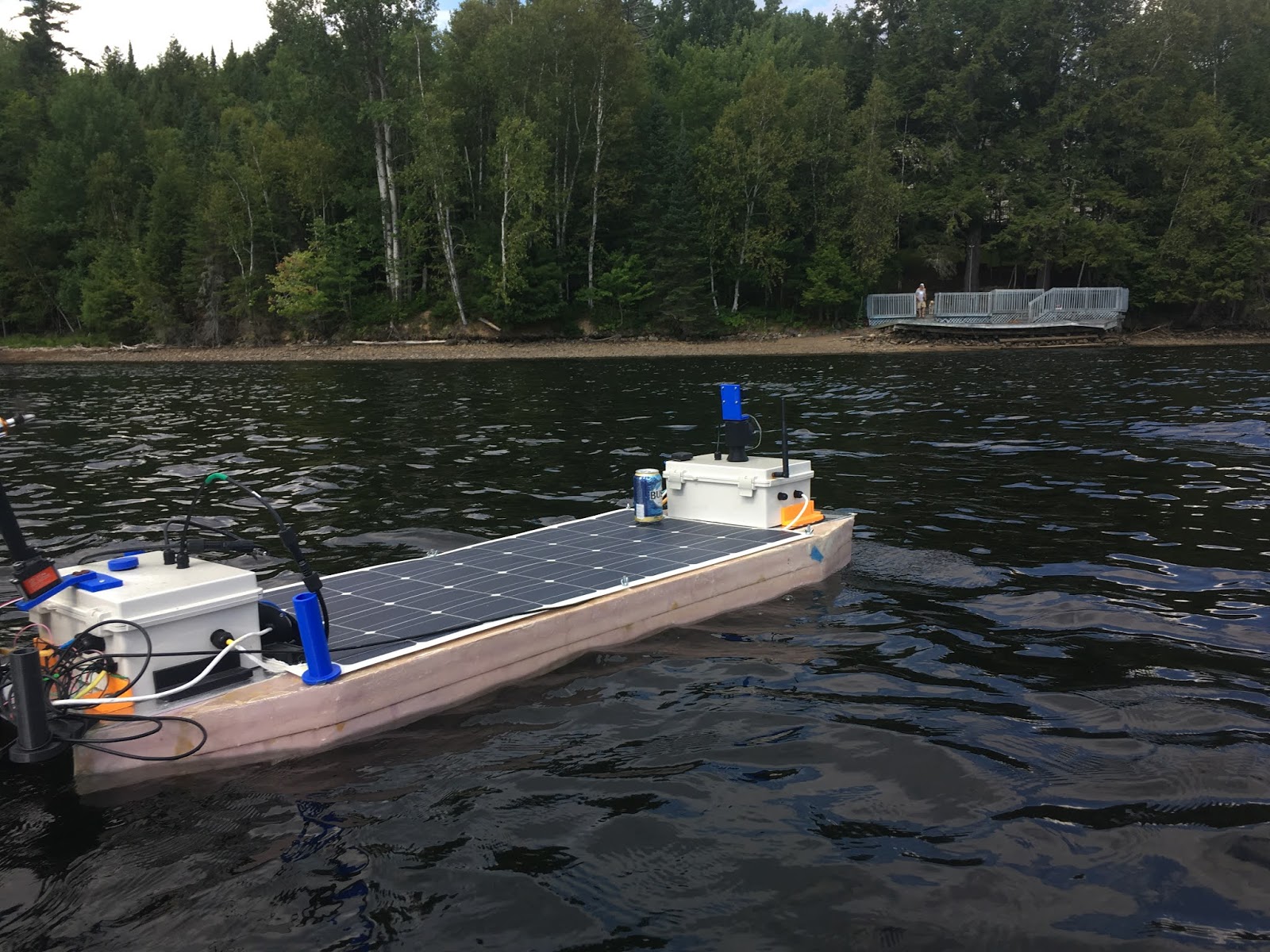
I was able to observe a number of small fish in the water, and there were a few people out fishing as well. A couple of them enjoyed paddling out to meet AMOS in the water, and were impressed that it stopped before hitting them and turned to go in a different direction. They even gave AMOS a can of beer. 😊


Tuesday, July 21, 2020

AMOS WAS H

This weekend, a second attempt at writing a complete geo-message on the St. John River was made:


Due to the cloud cover that day, AMOS didn't have enough charge to complete the approximately 10 km message: "AMOS WAS HERE". The intended route was indicated in the above screenshots by the yellow path. The GPS points listed in the ship's log file are the white points at top, and the measured depth data (collected every second) appears below.

The dissolved oxygen software was coded last week, and the actual equipment arrived yesterday, so hopefully tomorrow I'll find some time to hook it up and try out the calibration routine (it can be calibrated in air to atmospheric oxygen levels). 

A few days were also devoted to working out some bugs (really just code that was never finished) for various network communications routines in the new BoatCaptain user software. 

We are also now trying to find beta test locations for AMOS. If you happen to know of anyone needing automated, geographically distributed water monitoring (preferably in Atlantic Canada), please let me know!!! 


Tuesday, July 14, 2020

Poor Printed Paddle

This evening I thought it might be cool to do a video demo for the blog of the prototype paddle that I 3-D printed. Until you actually try something, you're never really sure how it's going to go. Hope you have a good laugh:


The paddle was hinged so that it would bend freely in one direction but would be unable to bend in the other direction. In theory, this would allow a back and forth motion of the paddle to propel AMOS forward. I guess I'll need to think some more on the mechanical design of this one.

Today I also started writing some code for a new dissolved oxygen probe from Atlas Scientific. It uses an I2C interface and is fairly well documented, so it shouldn't be too hard to add. It had been on back order for about a month, but just shipped yesterday, so hopefully it will be here soon:


Other software work this week has been completed on the Boat Captain program for downloading data and log files from AMOS. 

On Friday afternoon, I did a short live demo of AMOS in downtown Fredericton. Everything worked great! Here's the track comparison image, depth data and a nice picture that AMOS took before it returned to the launching point:


Tuesday, July 7, 2020

New Distance Record

AMOS set a new single-trip distance record on the weekend, but just barely: 10.95 km. According to this blog, the previous record was 10.85 km set last year. I had a route planned for a little over 12 km, but ran into a strong headwind on the final stretch and had to leave to go home for supper. Here's a video of the boat approaching the Walking Bridge:


Lots of people in motorboats paused to inspect AMOS on its journey, but luckily no one took it. Perhaps the crazy jumble of wires coming out of the back box act as a deterrent. I should probably transfer the warning text that I made for last year's AMOS to this one.

Here's the route that AMOS took, expressed as depth data:


The new 30A dual-motor driver arrived in the mail this week and I eagerly hooked it up to try it out, but goofed and reversed the + and - 12 volt battery wires by mistake. So... I never got it working and it now seems to be a brick. A replacement is on its way, but according to Amazon it's not expected until September. I got a shipping notification today though, so hopefully it won't really take that long.